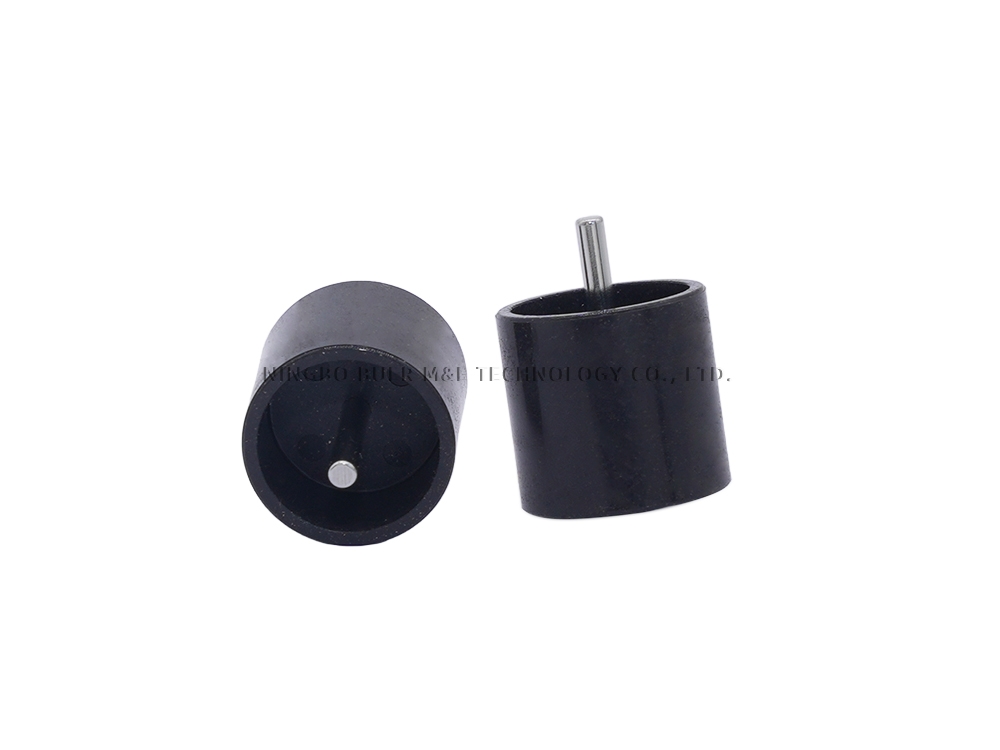
Plastic magnets Plastic magnets, fully known as plastic-bonded magnets or bonded magnets, are functional composite materials formed by blending magnetic powder (such as ferrite, neodymium iron boron, etc.) with a polymer plastic (like nylon, polyphenylene sulfide) as a binder, and then shaping them through processes like injection molding, extrusion, or calendering. They ingeniously combine the easy processability and complex shape-forming capability of plastics with the magnetic properties of magnetic materials.
Here is a detailed explanation of plastic magnets:
1. Core Concept: A Composite Material
Think of it as a "magnetic cookie":
Magnetic Powder (The "Chocolate Chips"): This is the core material providing magnetism, typically fine powders of permanent magnet materials like Neodymium Iron Boron, Ferrite, or Samarium Cobalt.
Plastic Binder (The "Dough"): This forms the matrix, usually engineering plastics like Nylon, Polyphenylene Sulfide, or Polypropylene. It encapsulates the magnetic powder and, after being heated to a molten state and molded, gives the product its final shape and mechanical strength.
2. Key Manufacturing Processes
The manufacturing of plastic magnets mainly involves the following steps:
Mixing and Pelletizing: Precisely proportioned magnetic powder, plastic pellets, and various additives are uniformly mixed, then heated, melted, extruded, and cut into granular raw material (called compound pellets).
Molding: This is the most critical step, primarily done through:
Injection Molding: The most common and versatile method. Pellets are heated until molten and injected into a precision mold, cooling to form magnets with complex shapes.
Extrusion Molding: Continuously extruded through a die to form long strips, tubes, or magnets with specific cross-sections, which are then cut to length.
Calendering: The mixture is calendered into thin, flexible magnetic sheets.
3. Main Advantages and Characteristics
High Design Freedom & Complex Shapes: Enables one-time molding of magnets with complex geometries and multi-pole magnetization (e.g., gears, rotors with integrated bearing seats), which is difficult to achieve with traditional sintered magnets.
Excellent Dimensional Accuracy and Consistency: The injection molding process ensures high precision and consistency in mass production, reducing the need for secondary machining.
Good Mechanical Properties and Toughness: The plastic matrix makes them resistant to chipping and able to withstand impact and centrifugal forces generated by high-speed rotation.
Lightweight: Their density is generally lower than that of sintered magnets, contributing to component weight reduction.
Integratability: Allows the magnet to be molded integrally with other structural components (e.g., bushings, gears) in one step, achieving functional integration and reducing part count and assembly costs.
4. Application Fields
Plastic magnets are widely used in fields requiring high performance, complex shapes, and reliability:
Automotive Electronics: e.g., rotors for BLDC motors in water pumps, oil pumps, and fans; micro-motors in power windows and seat adjusters; sensor rings.
Consumer Electronics: e.g., vibration motors in mobile phones, spindle motors in computer hard disk drives, auto-focus modules in cameras.
Home Appliances: e.g., damper actuators in air conditioners, drain pumps in washing machines, motors in kitchen appliances.
Industrial Automation: e.g., servo motors, encoders, sensors.
5. Challenges and Limitations
Magnetic Properties: Due to the presence of non-magnetic plastic binder, their magnetic energy product and maximum operating temperature are generally lower than those of sintered magnets made from equivalent materials.
Cost: High-performance magnetic powders (e.g., Neodymium Iron Boron) can be costly.
Process Requirements: Extremely high demands on raw material uniformity, mold precision, and control of molding process parameters.
Summary
Plastic magnets are high-performance materials created by compounding magnetic powder with a plastic binder. They are not intended to replace traditional sintered magnets but offer a unique solution for applications requiring complex shapes, high dimensional accuracy, high strength, and integrated molding. With technological advancements, plastic magnets are becoming indispensable key materials in modern high-efficiency motors, precision sensors, and miniaturized electrical appliances.


 浙公网安备 33028102001233号